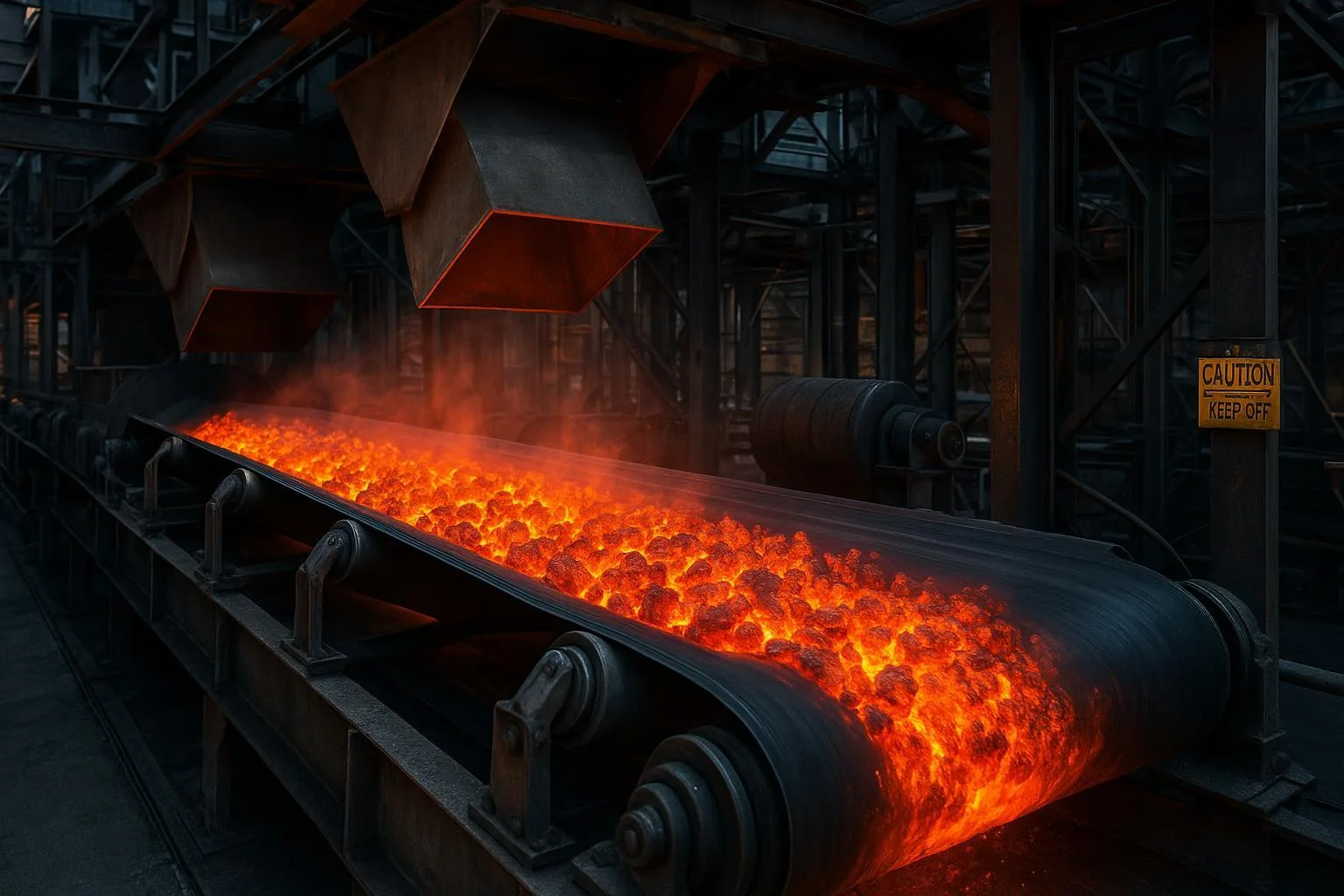
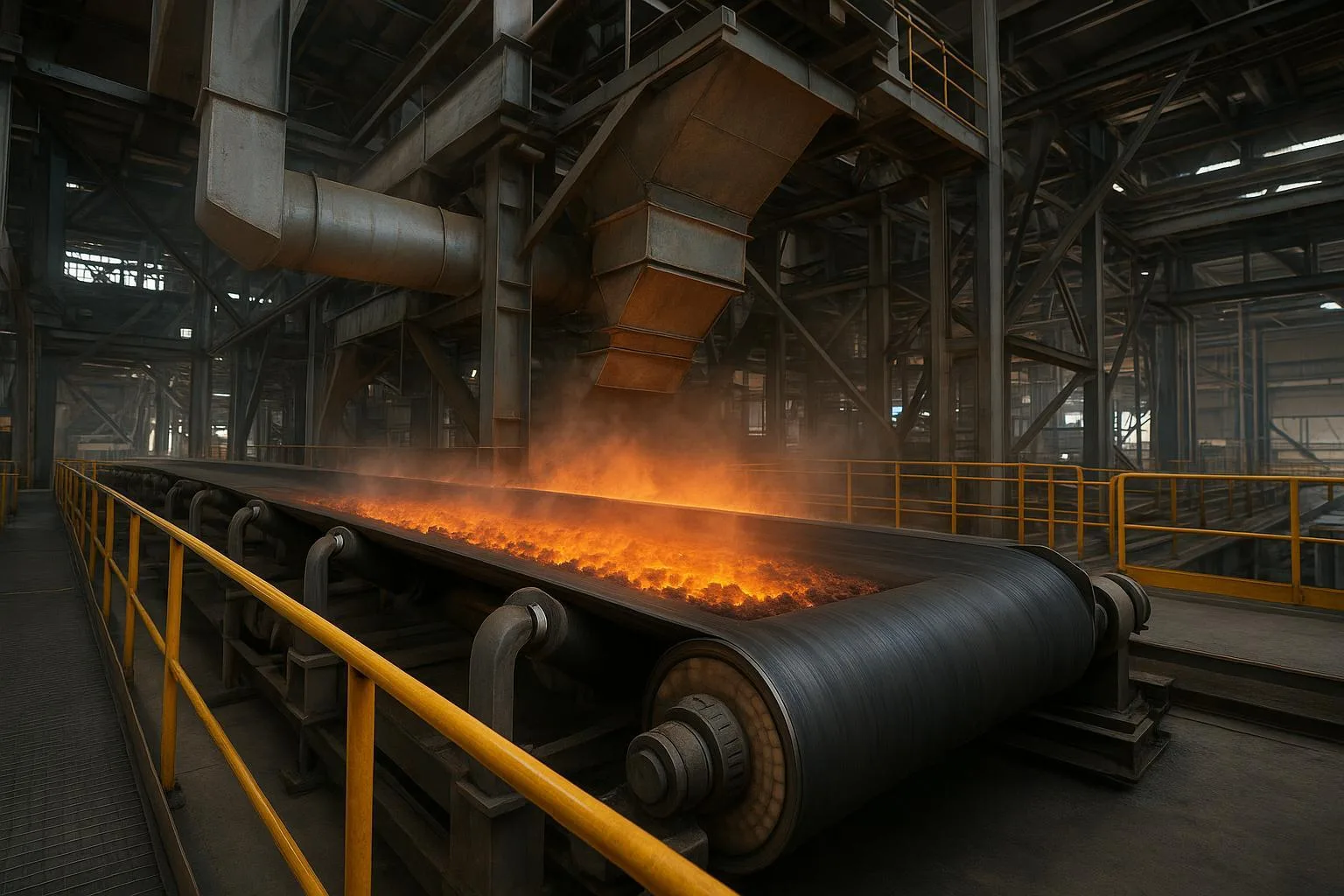
For a heat-resistant conveyor belt carrying clinker, start with the measured exposure and the complete conveyor duty—not a temperature label alone. Material temperature, belt-surface temperature, contact duration, loading and cooling conditions are different inputs. This checklist helps engineering and procurement teams organize those inputs for supplier review. It is not a universal operating-temperature limit, an installation procedure or a BisonConvey service-life guarantee.
1) Input and temperature profile: design from measured heat, not estimates
Have the responsible site team define a safe measurement plan. Record material and belt-surface temperatures separately, identifying the location, instrument, measurement method and operating state. Include normal operation, starts/stops, surges and any unusually hot lumps; record the duration and frequency of peaks rather than only the highest reading. The measurement frequency and acceptance margins belong in the approved project plan, not a generic checklist.
Request the proposed belt supplier's written temperature/exposure limits and supporting test evidence for the exact construction. As a manufacturer-specific example, Fenner Dunlop publishes separate continuous and peak material-temperature statements for its Superfort heat-resistant belts. Those statements apply to its named products; they are not transferable to every heat-resistant belt or to BisonConvey's catalog.
- Manufacturer reference: Fenner Dunlop Superfort Deltahete and Betahete. Check the current datasheet and application conditions directly with the proposed supplier.
2) Specify the heat resistant conveyor belt for clinker: compounds and covers
Choose the cover compound against the measured exposure, then request relevant heat-resistance and abrasion evidence. ISO 4195 addresses rubber-cover heat resistance; it is not a rating for the entire installed conveyor. ISO 4649 concerns abrasion testing, not a direct service-life prediction. Confirm each method's applicability and agreed acceptance criteria for the proposed product rather than treating a report title as approval.
Document the stated continuous and peak exposure, cover designation, agreed test methods/editions and acceptance criteria. Ask for results linked to the proposed compound and construction, including abrasion-after-aging data if required and available. A laboratory heat-aging temperature is not automatically a continuous material-temperature rating; a grade label is not a batch test report.
-
Reference: the official ISO 4195:2026 record identifies the scope of rubber-cover heat-resistance requirements and tests. Check the specified edition, cover-thickness and product-scope restrictions in the full method; the public record is not the full standard.
-
Reference: the official ISO 4649:2024 record describes rotating-drum abrasion methods. Record the specified method and reporting basis; laboratory abrasion results must not be converted into an assumed belt lifespan.
3) Carcass and splice: steel cord vs. EP/NN under high heat
Do not choose steel cord or EP/NN from temperature alone. Review calculated tensions, conveyor geometry, take-up travel, impact, available pulley diameters and the heat exposure of the complete construction. Published heat-resistant fabric-belt products show why a fixed temperature threshold is not a universal reason to switch carcass type. The supplier must confirm the proposed carcass, covers and adhesion performance together.
Request the belt manufacturer's approved splice drawing, materials and instructions for the exact construction and service. Do not use a generic “finger” or “step” label as a substitute for the required steel-cord or textile splice design. Agree acceptance evidence and responsibility for field work before ordering.
Check and record the supplier's minimum pulley diameters for the proposed belt construction and duty, including any hot-service restrictions. Existing pulleys and transitions must be assessed by the responsible designer; an arbitrary increase by one size is not a design rule.
4) Pulleys and lagging: diameter, crown, and slip control under heat
Record pulley diameters, face widths, lagging condition, wrap and drive/take-up data. Ask the belt and pulley suppliers to assess the interfaces under the stated heat exposure. Ceramic lagging is an option to evaluate, not a mandatory choice for every clinker conveyor. For a replacement assembly, check the drive pulley drawing and lagging inputs; this does not confirm a particular configuration is suitable.
5) Width, speed, and tension: stay conservative and calculate with standards
Record required capacity, belt width/speed, material properties, lift, route and transfer conditions. Ask the responsible designer to evaluate loading, tensions, take-up and component limits using the agreed calculation method. No width-to-speed table can establish a safe or suitable clinker duty on its own.
- Reference: the CEMA Belt Book change pages and CEMA Chapter 6 excerpt are historical references, not a project approval. Confirm the applicable calculation basis and edition with the responsible designer and component suppliers.
If preliminary calculations are needed, use the belt tension planning tool to organize inputs and identify missing data. Its output does not approve a heat-resistant belt, pulley or splice.
Tension and take‑up: use DIN 22101 or CEMA as the calculation basis. Adjust resistances for elevated temperatures (friction factors can change with hot covers and bearings), include accessory drag from scrapers and skirt seals, and size take‑up travel to accommodate thermal growth. Keep a clear calculation sheet in the project file and re‑run it if you change cleaner models or skirt geometry.
6) Idlers, sealing, and cleaners: specify for temperature and access
Idlers: determine the required duty from the actual loading, speed, geometry and environment rather than assigning a CEMA class from the word “clinker.” Request product-specific bearing, seal and lubricant information, including relevant temperature restrictions. Record the required test or rating basis and confirm it with the supplier.
Sealing and impact control: stabilize the loading zone with impact cradles and set dual‑lip or apron‑type skirt sealing with adequate access for adjustment. Robust sealing reduces carryback and shields cleaner blades from excessive loading.
Cleaners: request the selected model's blade material, belt-surface temperature and speed limits, splice compatibility, mounting requirements and maintenance instructions. A temperature advertised for another blade or assembly cannot establish this model's suitability. Availability of cleaners or other project accessories must be checked separately from the belt quotation.
- Reference: use the Flexco belt cleaner product directory to locate the selected model's documentation. The directory alone does not establish its temperature suitability.
7) Transfers and dust control: reduce residence time and heat load
Every second clinker lingers in a rock‑box or chute is heat soaking your belt. Design transfers to minimize dwell time, prevent buildup, and maintain consistent loading. Use wear‑resistant, low‑friction liners where appropriate; position flow aids (e.g., air cannons) to clear hang‑ups; and size dust extraction to keep fines from recirculating onto hot surfaces.
The Martin Engineering transfer-point brochure is a component-design reference. Ask the responsible designer to review its applicability to the measured clinker duty; it is not evidence of a BisonConvey installation or a quantified reduction in heat load.
8) Splicing in hot service: process control and acceptance evidence
Plan the splice scope with the belt manufacturer and responsible installation team. Obtain the approved splice geometry, compatible materials, product-specific curing instructions and agreed inspection/acceptance requirements. Keep drawing revisions and responsibility for field work in the work pack; this article supplies no curing recipe.
Acceptance evidence should identify the relevant belt or splice test method, edition and agreed criteria—not just a standard name. Ask which adhesion, splice-strength or cord-related evidence is relevant and available for the construction you are buying; the methods are not interchangeable. Keep the supplier's confirmation with the purchase record.
9) Commissioning and monitoring: staged hot‑run with frequent checks
Commissioning must follow the approved site plan and component suppliers' instructions. Define authorized measurement locations, operating states, stop criteria and who can make adjustments. Record material/belt temperatures, tracking observations, take-up position and condition photos using the site's safe access arrangements. Do not adjust cleaners or other components using this article as an operating procedure.
Agree monitoring intervals with the maintenance team and suppliers for the actual duty. Keep comparable records of cover condition, cracking, splice condition and temperature exposure so future replacement inquiries are based on evidence rather than an assumed lifetime.
10) Procurement and documentation: build TCO into the paperwork
Use a document register rather than assuming every supplier provides the same package. List the required drawing revisions, temperature records, construction/compound data, agreed test reports, pulley/interface review, component datasheets, splice plan and dispatch records. For each item, record the issuing party, applicable product/batch, availability, approval status and any deviations. Confirm support and warranty responsibilities in the order terms.
RFQ inputs, roll schedule and delivery documents
| Buyer input | What the quotation should clarify |
|---|---|
| Material and belt-surface temperature records, peak duration/frequency and exposure location | Proposed construction and compound; written application limits and deviations, not a generic temperature promise |
| Full belt designation, width, covers, route/tension data and existing pulley geometry | Supplier review of construction and interfaces; applicable drawings and datasheet |
| Splice method, field-work scope and required documents | Approved splice plan, material scope, responsibility and available acceptance evidence |
| Total purchase length and required length per roll | Roll count, whether splice allowances are included, and reconciliation with the approved installation plan; no fixed number of splices is assumed |
| Maximum accepted package dimensions/weight, destination and receiving restrictions | Proposed roll diameter, packed dimensions, net/gross weights, packing arrangements and included/excluded charges |
| Required roll IDs, inspection and dispatch records | Document availability, product/batch mapping and unresolved requirements before order acceptance |
Review the heat-resistant belt construction requirements with your measured duty. For roll and receiving details, use the packing and delivery review checklist. Neither page replaces supplier confirmation for the specific construction.
Compare proposals on the same basis
Compare quoted construction, exposure limits, inspection evidence, splice scope, packing and delivery assumptions side by side. A lower price with missing requirements is not directly comparable to a fully specified proposal. This checklist aims to make gaps visible; it does not establish a service-life or cost-saving result.
Frequently mis‑specified items to watch
-
Selecting a compound from a single peak reading without recording normal exposure, peak duration and frequency, and the supplier's stated application limits.
-
Ignoring abrasion after heat aging, which can flip the wear ranking of candidate compounds.
-
Reusing ambient‑service pulley diameters on a continuously hot line, accelerating bending fatigue and splice stress.
-
Choosing a cleaner blade that softens or glazes at the real belt surface temperature, reducing cleaning and increasing carryback.
-
Skipping take‑up travel allowances for thermal growth, leading to chronic tracking issues.
Standards and references used in this workflow
-
Heat‑resistant compounds and cement duty examples with ISO 4195 context are discussed in Fenner Dunlop’s cement industry resources and heat‑resistant bulletins and articles (2011–2022). Representative resources include the cement application page and a heat‑resistant technical bulletin that links ISO 4195 behavior to compound selection.
-
ISO method anchors for procurement acceptance: ISO 4195 (cover heat resistance) and ISO 4649 (abrasion tests). See the ISO overview and standard pages for method scope and reporting.
-
Speed and tension methodology: CEMA Belt Book change pages and Chapter 6 excerpts provide recommended speed limits by duty and the calculation framework; apply DIN 22101 or CEMA consistently and include accessory drag and thermal adjustments.
-
Cleaner temperature envelopes and model selection: Martin Engineering’s belt cleaner catalogs and Flexco’s product pages document temperature and speed ratings used for blade and cleaner selection in hot service.
Use measured duty, construction-specific documents and an agreed acceptance plan to prepare the purchase. Supplier review and site approval are still required; no customer case or lifespan result is claimed here.
Next step: submit a clinker belt specification for supplier review. Include temperature records, existing belt details and the roll schedule. BisonConvey coordinates the inquiry; feasibility, documents, commercial parties and order terms are confirmed in the quotation.