STEEL CORD CONVEYOR BELTS

STEEL CORD REINFORCED CONVEYOR BELTS
Steel cord conveyor belts use longitudinal steel cables embedded in rubber for high-tension bulk-material conveying. They are considered for mining, ports, cement and power-plant conveyors where belt tension, take-up travel and splice requirements justify a steel cord construction.
BisonConvey helps organize belt specifications and coordinate supplier quotation review. Send your ST rating, width, top and bottom cover thicknesses, operating conditions and delivery schedule. The proposed construction, available dimensions, lead time and supply scope must be confirmed for each project.
For cold-climate projects, provide minimum ambient and cold-start temperatures separately from material temperature. A cold-resistant description or an abrasion grade is not a verified temperature limit; request written belt and splice-material suitability with the applicable test evidence.
TECHNICAL DATA
WHY CHOOSE THIS PRODUCT
- ST rating, cord layout and cover requirements recorded separately
- Cold-climate requirements reviewed without assuming a universal temperature rating
- Splice materials quoted against belt construction and an approved splice drawing
- Roll lengths, packing limits and destination included in delivery review
- Supplier datasheets, test reports and deviations requested at quotation stage
- Actual seller, supply scope and warranty terms confirmed before order
APPLICATIONS
How to Read a Steel Cord Belt Designation
An illustrative designation, 1600 ST2000 8+5 X, separates width, tensile class and cover requirements. Notation varies by supplier: expand each field in the RFQ and specify the controlling standard and edition. This example is not a confirmed supply specification.
- ST
- Steel cord carcassLongitudinal steel cables embedded in bonding rubber. Request the cord construction, diameter, pitch and count; the ST designation alone does not define the complete carcass.
- 2000
- Nominal breaking strength (N/mm)ST2000 denotes nominal belt breaking strength of 2000 N/mm, numerically equal to 2000 kN/m. It is not allowable operating tension. The conveyor designer must evaluate actual loads, splice performance and the applicable design method.
- Cord Ø / pitch
- Cable diameter and spacingConfirm actual diameter, centre-to-centre pitch, cord count and tolerances on the supplier drawing. If a translated specification and drawing disagree, resolve the controlling value in writing rather than selecting a diameter from the ST rating.
- 8+5
- Cover thickness, top:bottom (mm)In this example, the carrying cover is 8 mm and the pulley-side cover is 5 mm. Their sum is not the finished belt thickness: the cord layer and specified construction must also be considered. Request a cross-section, total thickness and tolerances.
- X
- Cover grade requiring a defined specificationRequest the governing standard, edition and measurable cover properties. Do not treat X, SAR or a supplier's compound name as interchangeable or as proof of low-temperature performance.
Also state belt width explicitly: 1600 in this example means 1600 mm. A designation or standard reference is not a test certificate; request a supplier compliance/deviation schedule for the actual proposed belt.
Steel Cord Conveyor Belt RFQ Preparation
Use these steps to prepare comparable quotations. This is a procurement checklist, not a final conveyor design or a substitute for the belt supplier's engineering review.
Define the belt and conveyor duty
Provide belt width, requested ST class, conveyor length, lift, capacity, speed, drive arrangement and available tension calculations. For a replacement, attach the existing belt designation and drawings. Do not choose the final ST rating from an indicative calculator alone.
Estimate conveyor belt tension inputs before supplier review.Separate cover, cord and total-thickness requirements
List top and bottom covers, cord diameter and pitch, overall thickness and tolerances as separate fields. Describe lump size, sharpness, abrasion and loading impact; ask the supplier to propose suitable cover and protection options and identify any deviations.
Check pulleys, transitions and take-up
Supply pulley diameters and roles, local belt tensions, wrap angles, transition geometry and available take-up travel. Minimum pulley diameter depends on the proposed belt construction and duty, not ST class alone. Confirm compatibility before finalizing a replacement order.
Read the conveyor pulley diameter selection guide.Specify cold-climate conditions and evidence
State minimum ambient, cold-start and conveyed-material temperatures, exposure and stop/start conditions. Ask for written suitability and relevant test reports for the proposed belt and splice system. Cold-resistant belts and cold-vulcanizing adhesives describe different requirements.
Match splice materials and the roll schedule
Provide the approved splice drawing, belt compound, required materials and quantities, planned joints and spare allowance. Confirm TDS/SDS, batch identification, shelf life and storage conditions. Roll count alone does not determine splice-kit count; installation services are not assumed included.
Read the steel cord conveyor belt splicing guide.Submit the specification and delivery requirements
Attach your specification or BOM. Include each roll length and quantity, packing and handling limits, destination, required date, marking instructions and requested documents. The existing RFQ form accepts attachments; add steel cord details in the message when no separate field is available. Confirm the actual seller, export scope and warranty terms before ordering.
Submit your steel cord belt specification for quotation review.
Common Specification Mistakes
Resolve these specification ambiguities before comparing quotations. The examples are procurement checks, not claims about completed BisonConvey projects.
Treating cover thickness as finished belt thickness
Separate top cover, bottom cover and overall thickness. Ask for a cross-section with cord layout and tolerances; do not enter the cover sum as total belt thickness in an order.
Resolving conflicting values without written approval
A maximum cord diameter, nominal diameter and translated dimension may be different requirements. Record the conflicting versions and obtain a controlling value, tolerance and supplier response before quotation approval.
Assuming abrasion grade proves cold resistance
An abrasion designation and a cold-climate requirement address different properties. Specify the temperatures and required test evidence, and confirm the belt and splice compounds together.
Using roll count as the splice-material order quantity
Separate delivery rolls from installed belt loops, planned joints and spare kits. Confirm joint locations, the approved splice drawing and material quantities rather than multiplying every supplied roll by a fixed kit allowance.
FREQUENTLY ASKED QUESTIONS
When should I choose steel cord over a fabric belt?
Compare actual tensions, elongation and take-up requirements, pulley geometry, operating duty and splice arrangements. Steel cord is often considered for long or high-tension conveyors, but there is no universal length or ST threshold that makes it the correct choice for every project. Request a construction-specific assessment.
What does ST 2000 mean?
ST identifies a steel cord carcass and 2000 is the nominal breaking strength in newtons per millimetre of belt width. Unlike EP 500/4, the number is not per ply — a steel cord belt is a single plane of cables, so it describes the whole belt. An ST 2000 belt at 1200 mm width is rated at 2400 kN breaking strength.
Why do steel cord belts need bigger pulleys?
Steel cords must withstand repeated bending. The recommended diameter depends on cord and belt construction, local tension and pulley role; do not assume every steel cord belt needs the same minimum or that it is always larger than a textile equivalent. Request the proposed belt supplier's pulley recommendations.
What safety factor applies to steel cord belts?
A fixed number is not enough to approve a belt. The conveyor designer must evaluate the applicable design standard, loads and starting conditions together with the proposed belt and splice performance. An ST rating is nominal breaking strength, not allowable working tension.
How are steel cord belts spliced?
Hot-vulcanized cord splices are the usual permanent joint method. Use a supplier-approved splice drawing and compatible materials, with qualified personnel and suitable equipment. A procurement page cannot define universal cure temperature, pressure, time or step dimensions.
What transition distance does a steel cord belt need?
Confirm the transition geometry at both ends using troughing angle, pulley elevation, belt construction and operating tension. Do not approve a replacement from one universal width multiplier. Provide the existing layout for supplier or conveyor-designer review.
What are the layers of a steel cord conveyor belt?
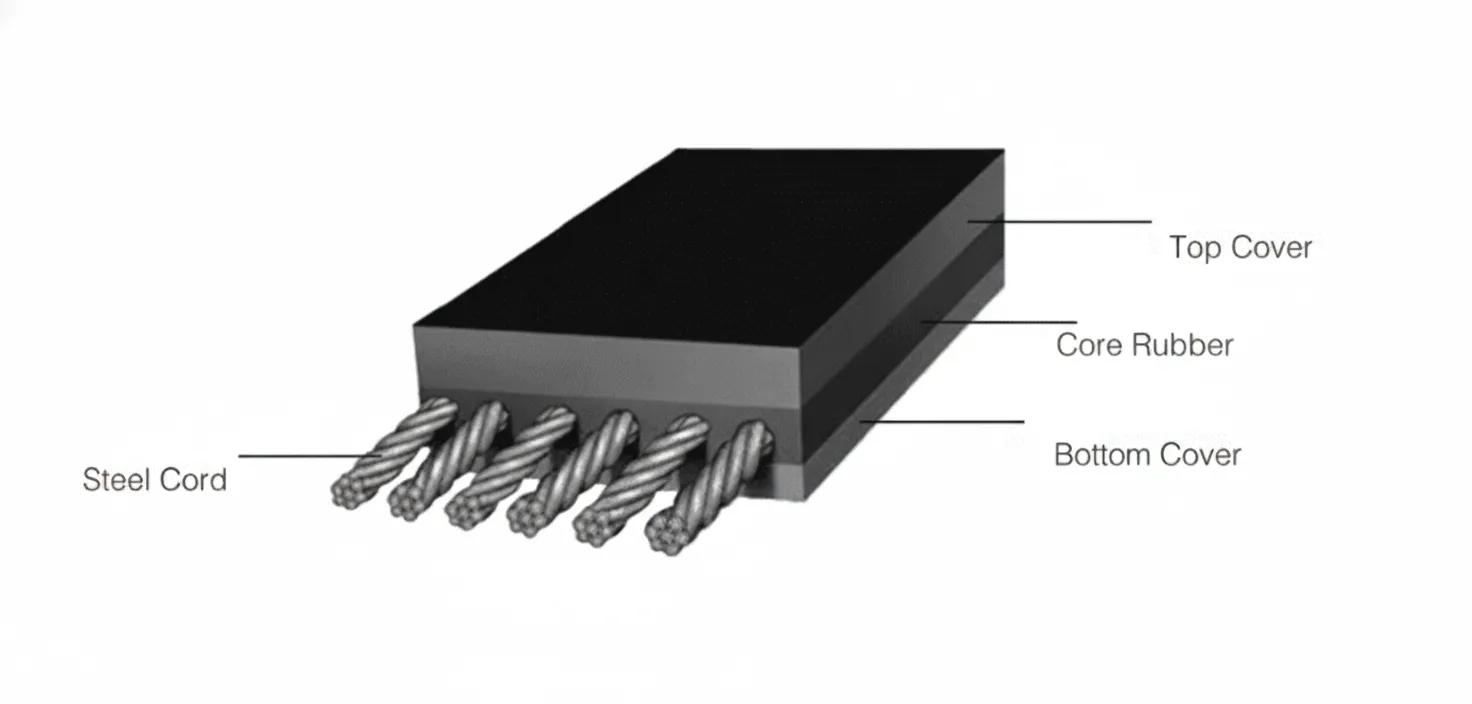
From the carrying face down: a rubber top cover, an optional fabric breaker ply, the core (bonding) rubber that embeds and insulates the cords, a single plane of zinc- or brass-plated steel cords running lengthwise, an optional bottom breaker, and a rubber bottom cover. The plating bonds the steel to the rubber and the core gum transfers load evenly into every cord. Unlike a fabric belt there are no plies to delaminate — the cords are one plane.
Which standards govern steel cord conveyor belts?
Specifications may reference ISO 15236 or DIN 22131, but the RFQ must identify the required document, edition and application. Request a compliance/deviation schedule and relevant test records. A standard reference does not establish certification or make all supplier constructions interchangeable.
How do steel cord belts resist rip and impact?
Two ways. Transverse breaker plies — fabric layers embedded in the covers above and below the cords — spread impact and resist a sharp lump driving a longitudinal rip along the belt. And because a rip that does start can run a long distance on a steel cord belt, high-value overland belts are often fitted with rip-detection: conductive loops embedded at intervals that break and trigger a shutdown when the belt is torn.
Steel cord or aramid — when does aramid make sense?
Compare the proposed belt constructions against the same tension, weight, elongation, pulley and splice requirements. Ask the conveyor designer and suppliers to document suitability and supply scope rather than choosing from a generic strength or cost comparison.
Does 10+6 mean a total belt thickness of 16 mm?
Not when the notation identifies 10 mm top cover and 6 mm bottom cover. Those are cover thicknesses only; request the supplier's cross-section, overall belt thickness and tolerances. Clarify any drawing or translated specification that calls the cover sum the finished thickness.
Can I request a cold-resistant steel cord belt?
Yes, submit the cold-climate requirement for supplier review, including minimum ambient and cold-start temperatures, material temperature and acceptance criteria. Availability and performance require written confirmation for the proposed belt and splice system. No universal minimum temperature is guaranteed on this page.
Are splice kits and installation included with the belt?
Do not assume they are included. List belt rolls, splice materials, solutions, spare allowance and any installation request separately. Ask for compatible materials, TDS/SDS, batch dates, shelf life and storage instructions. The supplier quotation must identify what is included and excluded.
Free tools for sizing this product
Run the numbers before you send an RFQ — no signup, no email.
Download the STEEL CORD REINFORCED CONVEYOR BELTS spec sheet
Full specifications, cover grades, tensile classes, and application recommendations — one PDF to share with your engineering team or procurement.
PDF · A4 · English